
Oto
A tinnitus program that pairs you with an audiologist who specializes in tinnitus, alongside a daily app of short guided exercises based on cognitive behavioral therapy.
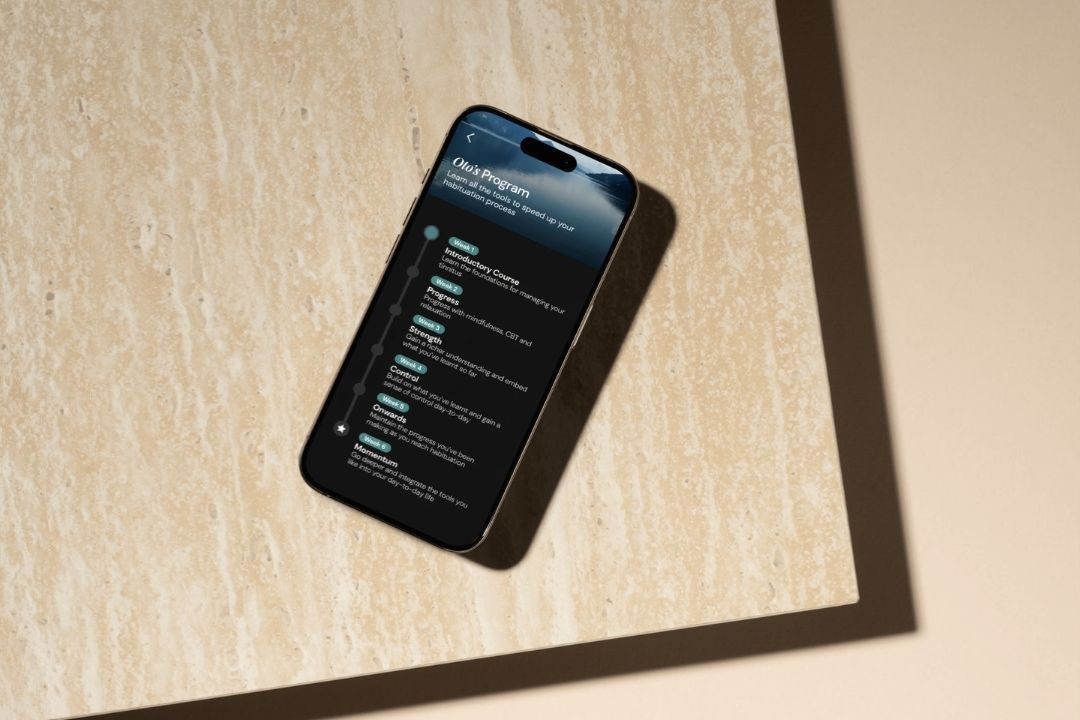
How does Oto work?
Oto combines care from a tinnitus-focused audiologist with an app you use at home on your phone. The app has short guided exercises based on cognitive behavioral therapy (CBT), a library of background sounds and soundscapes, wind-down routines for bedtime, and breathing and mindfulness exercises for stress and focus.
The program works on how much tinnitus intrudes on your sleep, your focus, and your mood. The CBT exercises focus on how you respond to the sound and help you build coping skills. Your audiologist can see how you are getting on in the app and adjusts your plan as you go.
Oto runs on iPhone and Android phones. Your clinic sets up your account, so there is nothing to buy in the app itself.
Who is Oto for?
Oto Health, the company that makes Oto, has published no age limit, severity level, or exclusions for the program. Your audiologist decides whether it fits your situation, based on your hearing, your tinnitus, and what you hope to change.
It tends to suit people whose tinnitus affects their sleep, concentration, or mood, and who can fit a short daily exercise into their routine over several weeks. If your main hope is for the sound itself to stop, talk that through with your audiologist first, since CBT-based programs are built around your response to tinnitus.
What does the evidence say?
Every treatment page on Tinnitus Support lays out the evidence the same way, so you can compare options on an even footing.
The studies
Oto has been tested in two randomized trials run by university teams. A trial at Flinders University in Australia compared Oto with a waiting list in 96 adults who had lived with tinnitus for at least six months, and it was published in 2025. A larger UK trial called DEFINE, led by the University of Cambridge, compared the app with one-to-one therapy from a therapist. Its protocol planned for 198 participants, and 210 people enrolled. Results are in peer review.
Oto Health helped fund both trials. The Flinders trial was co-funded by Flinders University, and DEFINE by Innovate UK, the UK government's innovation agency.
What was found
In the Flinders trial, scores on the Tinnitus Functional Index, a questionnaire about how much tinnitus affects daily life, fell by 9 points more in the Oto group than in the waiting-list group at six months. At that point, 32% of the Oto group reported a clinically meaningful improvement, against 12% of the waiting-list group. Participants knew which group they were in, and about a fifth dropped out over the course of the study.
The approach behind Oto has strong guideline support. Two US guidelines support CBT for adults with bothersome tinnitus. The 2014 guideline from the American Academy of Otolaryngology (the US professional body for ear, nose, and throat doctors) recommends it, and the 2024 guideline from the US Department of Veterans Affairs and Department of Defense suggests it, which is a lighter grade. A Cochrane review of 28 studies with 2,733 participants concluded that CBT may reduce the negative impact tinnitus has on quality of life, based on low to moderate certainty evidence. In the UK, the National Institute for Health and Care Excellence (NICE), which sets national health guidance, lists digital CBT for tinnitus, provided by psychologists, as the first psychological step for tinnitus-related distress.
The Veterans Affairs guideline looked at app-based self-management for tinnitus in general and found too little evidence to recommend for or against it. That review covered research up to April 2023, before the Flinders trial was published.
How Oto is provided
Oto is a digital program offered through independent audiology practices in the US. Oto Health describes it as providing education and coping techniques for people with tinnitus. Your audiologist decides whether it suits you and follows your progress between visits.
Worth knowing
The DEFINE trial compared the app with one-to-one therapy, so its results will say a lot about how app-based CBT for tinnitus compares with seeing a therapist. We will update this page when those results are published.
Your clinic sets how long you keep access to the app. Oto Health says most clinics give around 12 months and some give lifetime access, so it is worth asking when you book.
Sources. Mui and colleagues, randomized controlled trial of the Oto app, Speech, Language and Hearing, 2025. Smith and colleagues, DEFINE trial protocol, PLOS ONE, 2024. Salem and colleagues, DEFINE trial methods paper, PLOS ONE, 2025. Oto Health research, program, and pricing pages, accessed September 2026. AAO-HNSF Clinical Practice Guideline, Tinnitus, 2014. VA/DoD Clinical Practice Guideline for Tinnitus, 2024. Cochrane review CD012614, Cognitive behavioural therapy for tinnitus, 2020. NICE guideline NG155, Tinnitus assessment and management, 2020.
Last reviewed September 2026
Oto FAQs
Do I need to see an audiologist to use Oto?
Yes. Oto is offered through audiology practices, and your audiologist assesses your tinnitus and hearing first. Together you build a plan that combines the app with their care, and they set up your account and follow your progress between visits. You can search Tinnitus Support by city to find a clinic offering Oto.
Will it make the sound go away?
Oto is designed to reduce how much tinnitus affects your sleep, your focus, and your mood. The CBT exercises focus on how you respond to the sound. In the Flinders trial, about a third of people using Oto reported a meaningful improvement at six months. Your audiologist can talk through what to expect for your own tinnitus.
How much time does it take each day?
Oto Health describes the app as taking about 10 minutes a day between appointments. Your audiologist sets how long your plan runs, based on how you are getting on. Ask at your first visit how often they expect to see you, so you know what the weeks ahead will look like.
How is Oto organized differently from a tinnitus app I download myself?
Oto is used alongside care from an audiologist. Your clinic sets up your account, your audiologist can see your progress in the app, and they adjust your plan at each review. That means a clinician is involved from your first assessment and stays involved while you use the app.
Is Oto the same as CBT with a therapist?
Oto delivers exercises based on CBT through an app, alongside care from your audiologist. The DEFINE trial compared the app with one-to-one therapy from a therapist, and its results are still in peer review. If you would like one-to-one sessions, ask your clinic whether they work with a psychologist or counselor.
Who paid for the research on Oto?
Oto Health helped fund both trials. The Flinders trial was co-funded by Flinders University, and the Cambridge-led DEFINE trial by Innovate UK, a UK government agency. For DEFINE, the trial team reports that Oto Health helped design the study and an independent research organization handled data collection and analysis. Each paper publishes its own conflict of interest statement.
Ready to talk it through?
Clinics listed on Tinnitus Support that offer Oto can assess your tinnitus and hearing, and talk through whether the program suits you.
This page is for general information about tinnitus treatments. It does not replace advice from an audiologist or doctor who has assessed your hearing. Treatment suitability and results vary from person to person.
Published September 2026 · Last reviewed September 2026