
Tinnitus Pro
An app-based tinnitus program that pairs sound therapy with cognitive behavioral lessons and guided meditation, set up for you by a hearing care professional.
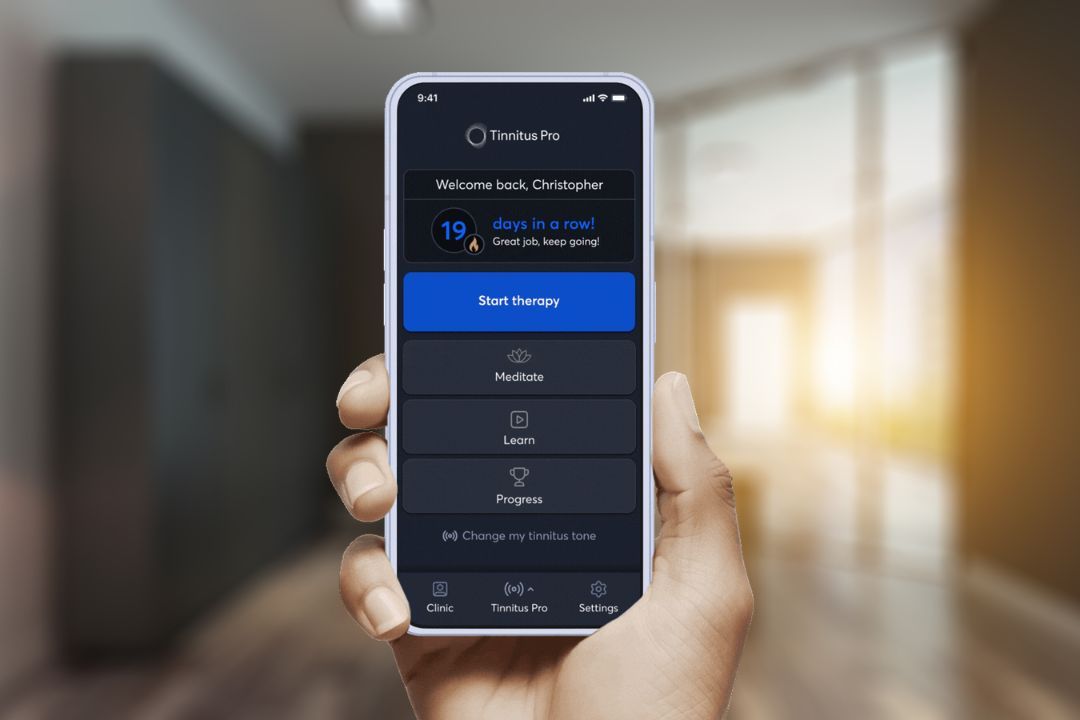
How does Tinnitus Pro work?
Tinnitus Pro is an app you use on your phone or tablet. It brings three kinds of support into one place. There is sound therapy shaped around the pitch of your own tinnitus, a set of lessons based on cognitive behavioral therapy (CBT), and guided meditation for relaxation and stress.
The program works on how much tinnitus intrudes on your day, your sleep, and your mood. The lessons focus on how you respond to the sound and help you build coping strategies. Your audiologist turns the app on for you and can see your progress between appointments.
A tone-matching tool helps you find the pitch closest to your own tinnitus, and the app uses it to shape the sounds it plays. There are four sound modes. Habituation adds steady, gentle sound for quiet parts of the day. Adaptation removes your tinnitus pitch from what you hear. Relief is for short sessions during a bad spell. Sleep plays soft sound at bedtime and then fades out. You can layer up to three background sounds with any of them.
Who is Tinnitus Pro for?
Neurotone, the company that makes Tinnitus Pro, has published no age limit, severity level, or exclusions for the app. Your clinician decides whether it fits your situation, based on your hearing, your tinnitus, and what you hope to change.
It tends to suit people who want help with how much tinnitus gets into daily life, sleep, and mood. If your main hope is for the sound itself to stop, talk that through with your clinician first, since CBT-based programs are built around your response to tinnitus.
What does the evidence say?
Every treatment page on Tinnitus Support lays out the evidence the same way, so you can compare options on an even footing.
The studies
Tinnitus Pro launched in November 2025. The research so far covers the approaches inside the app, each studied on its own, and its strength differs from one approach to the next. We will update this page as studies of the app itself are published.
What was found
Cognitive behavioral therapy has the strongest backing of the approaches in the app. Two US guidelines support CBT for adults with bothersome tinnitus. The 2014 guideline from the American Academy of Otolaryngology (the US professional body for ear, nose, and throat doctors) recommends it, and the 2024 guideline from the US Department of Veterans Affairs and Department of Defense suggests it, which is a lighter grade. A Cochrane review of 28 studies with 2,733 participants concluded that CBT may reduce the negative impact tinnitus has on quality of life, based on low to moderate certainty evidence. In the UK, the National Institute for Health and Care Excellence (NICE), which sets national health guidance, lists digital CBT for tinnitus, provided by psychologists, as the first psychological step for tinnitus-related distress.
Sound therapy is listed as an option in the Academy's guideline, a lighter grade than a recommendation, and the Veterans Affairs guideline suggests using sound for tinnitus self-care. The Habituation mode is based on tinnitus retraining therapy, where a Cochrane review found one eligible trial and too little evidence for firm conclusions. The Adaptation mode is based on notched sound. Recent reviews of that research have reached mixed conclusions, and the Veterans Affairs guideline found too little evidence to recommend for or against it.
The Veterans Affairs guideline looked at app-based self-management for tinnitus in general and found too little evidence to recommend for or against it. These findings describe the approaches the app is built on.
How Tinnitus Pro is provided
Tinnitus Pro is a digital therapy app offered through hearing care clinics. Your clinic sets up your access, and your audiologist decides whether it suits you and follows your progress between visits.
Worth knowing
Guidelines address approaches, so none of them name Tinnitus Pro. The Academy's guideline was published in 2014 and the Veterans Affairs guideline in 2024.
Neurotone's patient support pages suggest building toward 1.5 to 2 hours of Adaptation listening a day, which you can split into shorter sessions. Relief sessions run for 2 to 15 minutes, and time in the Sleep mode does not count toward the daily goal. Your clinic can help you work out a routine that fits your day.
Sources. Neurotone Tinnitus Pro product page and patient support pages, accessed September 2026. AAO-HNSF Clinical Practice Guideline, Tinnitus, 2014. VA/DoD Clinical Practice Guideline for Tinnitus, 2024. Cochrane review CD012614, Cognitive behavioural therapy for tinnitus, 2020. NICE guideline NG155, Tinnitus assessment and management, 2020. Cochrane review CD007330, Tinnitus retraining therapy, 2010.
Last reviewed September 2026
Tinnitus Pro FAQs
Do I need to see a clinic to get Tinnitus Pro?
Yes. Tinnitus Pro is available through licensed hearing care professionals, and your clinic turns the app on for you. If you open the app before that happens, you can tap a button to ask your clinic for access. A first visit is a good time to talk through whether it suits you.
Will it make the sound go away?
Tinnitus Pro is designed to reduce how much tinnitus affects your day, your sleep, and your mood. The CBT lessons focus on how you respond to the sound. Your clinician is the best person to talk through what to expect for your own tinnitus.
How much time does it take each day?
Neurotone suggests building toward 1.5 to 2 hours of Adaptation listening a day, split into smaller sessions if you like. Relief sessions run for 2 to 15 minutes during a bad spell, and the Sleep mode is for bedtime. Your clinician can help you set a pace that feels manageable.
What devices does it work on?
Tinnitus Pro runs as a mobile app on phones and tablets. The app is available in ten languages, including English, Spanish, French, and German. Your clinic can help you get it set up on your device at your first visit.
Can I go back to it later?
Yes. Neurotone describes access as lifetime, so you keep the app and can return to it if tinnitus flares again later. That can help if your tinnitus comes and goes, or if a stressful stretch brings it back to the front of your mind.
Is Tinnitus Pro the same as CBT with a therapist?
Tinnitus Pro includes more than 50 lessons based on CBT, delivered through the app. The guideline support described on this page is for CBT as an approach. If you would like one-to-one sessions, ask your clinic whether they work with a psychologist or counselor.
Can my audiologist see how I am doing?
Yes. Short surveys in the app track how tinnitus is affecting you, and your provider can view your progress in Neurotone's clinician portal between appointments. That gives you both something concrete to look at and talk through at follow-up visits.
Ready to talk it through?
Clinics listed on Tinnitus Support that offer Tinnitus Pro can talk through whether the app suits you and how they support patients who use it.
This page is for general information about tinnitus treatments. It does not replace advice from an audiologist or doctor who has assessed your hearing. Treatment suitability and results vary from person to person.
Published September 2026 · Last reviewed September 2026